
Skip to content

Trading, including shares, foreign exchange, spread bets and contracts for difference, can lead to the loss of more than a small stake. Futhorkzena publishes education from Fairlie. Nothing on this site is a personal recommendation, an offer to deal, or a forecast of profit.

Method

Prepare the session before the session prepares you.

The Futhorkzena method is a sequence of writing, not a set of calls. It fits a person learning UK hours: London cash shares, sterling, and the afternoon overlap. It does not tell you the direction of any market.

Overhead view of a trading journal, pen and brass ruler

01

Session map

Before you look at a price, write the clock. Which slice of the UK day are you actually available for? A plan that requires you to watch the US overlap while you are on a train out of Glasgow is not a plan.

List the scheduled items that can move your markets: Bank of England decisions and minutes, UK inflation and labour-market prints, fiscal headlines, and the US data that lands during the London afternoon. The Bank publishes its calendar. So do the Office for National Statistics and, for the United States, the relevant statistical agencies. Copy the times in UK clock, not in whatever zone the headline used.

Mark bank holidays. The London Stock Exchange does not follow a social-media idea of “the markets are always open”.
02

One sentence

If you cannot say the idea in one sentence, you do not have one. “I think it might bounce because it looks oversold and also the news is good and also I am down on the week” is three moods stapled together.

A usable sentence names the instrument family, the condition, and what would prove you wrong. Example of the shape, not of a trade: “If GBPUSD is still below the level I marked before the inflation print thirty minutes after the release, I have no long idea today.” The level is yours. We do not supply it.

Write the sentence before the open, or explicitly write “no idea; observation only”. Observation is a complete decision.

03

Risk unit first

Choose the cash amount you are willing to lose on the idea if the invalidation level is hit. That amount is one R. Position size is what falls out of R and the distance to invalidation. It is not a number you pick because the box on the ticket looked small.

Then choose a daily stop for the session: many learners use a small multiple of R, decided in writing, after which the platform is closed. The point is not the multiple. The point is that it exists before the first loss, when you are still polite to yourself.

If you do not know how the product’s point value, margin, or financing works, you are not ready to size it. Go back to the markets page and the broker’s own specification.

04

The journal line

After the session, one page. Not a novel. Record the sentence you wrote, whether you took the idea, the R result, and the rule you kept or broke. Screenshots without sentences become souvenirs.

Include costs you actually paid: spread or commission, financing if you held overnight, and FX conversion if the account is not in sterling. A gross price move that ignores costs is fiction.

05

Weekly review

Once a week, away from the open, answer the same questions. We suggest Sunday evening or Saturday morning, when the London week is shut.

  • How many sessions did I plan, and how many did I improvise?
  • Did I respect the daily stop, or did I renegotiate it?
  • Which losses came from a broken rule, and which came from a rule that worked and still lost?
  • Am I trading a product whose costs I can explain out loud?
  • What will I not do next week? Write the refusal in a full sentence.

A review that only celebrates winners trains you to hide the rest. Keep the dull pages.

A pre-session card you can copy

This is a blank structure. The values are examples of format, not levels to use.

  • Date and session. Tuesday, London morning only. Laptop closed at 12:00.
  • Calendar. No Bank Rate decision. UK data at 09:30. I do not hold a position through that print.
  • Bias. None until thirty minutes after the open.
  • Markets in view. One UK share I already understand, and EURGBP only if the morning data surprises. Not both at full size.
  • One R in cash. Written as a sterling amount I can lose without touching rent.
  • Daily stop. Two R, then the platform stays closed.
  • Second idea. Only if it was written before 08:00. Otherwise the day ends after the first.
  • Shutdown. Journal before I leave the chair. No “one more look” after dinner.
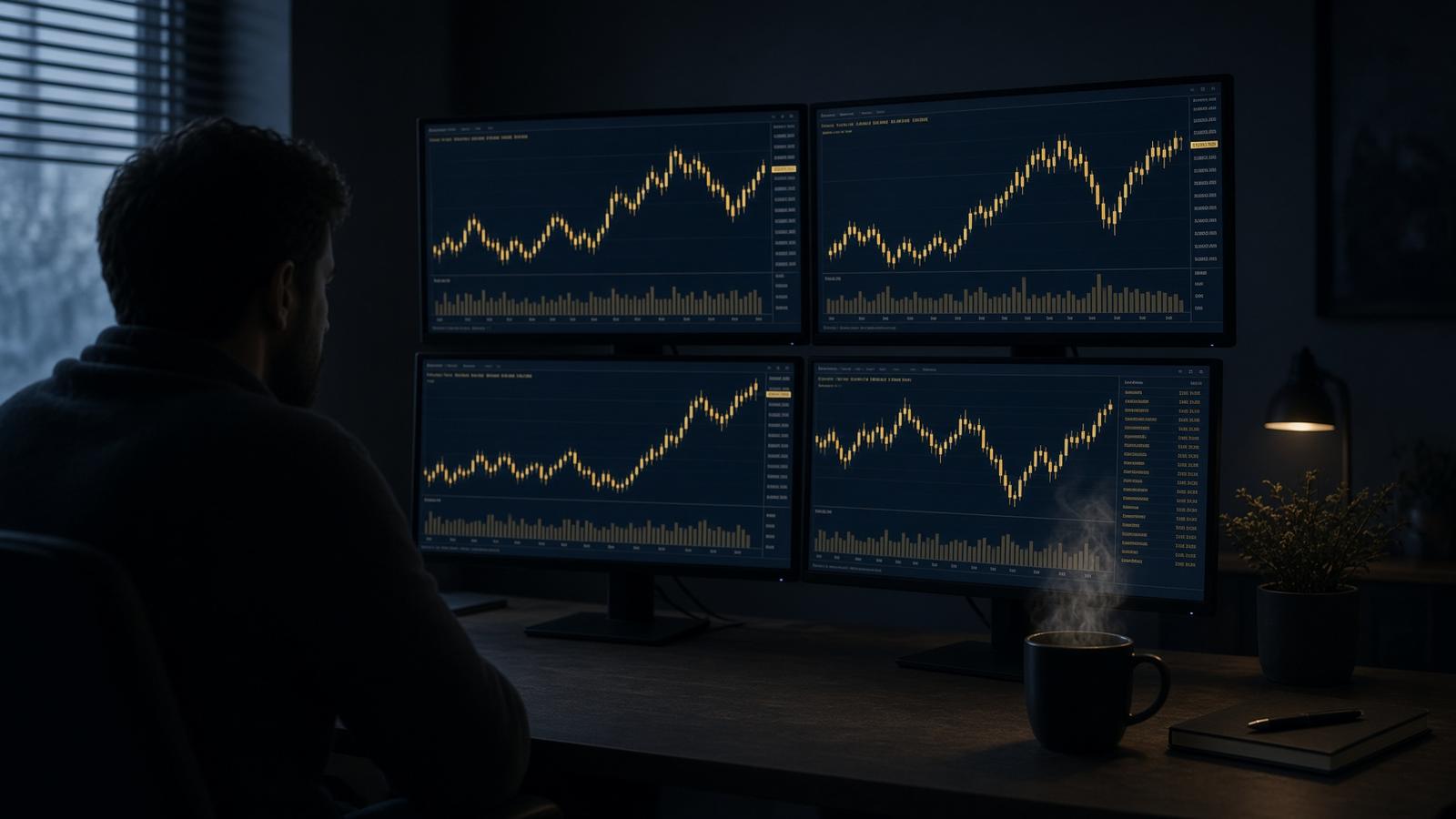
Dim room with several monitors showing abstract price charts

What we will not add to the method

We do not run a chat that shouts entries. We do not rent the studio’s name to a signal seller. We do not review your broker statement and tell you the next ticket.

If you want that, you want a different kind of firm, and you should be suspicious of anyone who offers it cheaply. Personal recommendations in the UK are a regulated activity. We do not carry it out.

Continue to risk discipline